If you’re building or refining an apparel brand, you eventually face a material decision:
Should you choose woven labels… or upgrade to leather?
Both are high-quality options. Both are durable. Both are used by established brands.
The real difference isn’t quality.
It’s perception.
And perception influences how customers experience your product before they ever check the price tag.
If you’re unsure which direction fits your brand, that’s normal. The right choice depends on positioning, garment type, and long-term brand goals.
Let’s break it down clearly.
How Material Choice Shapes Brand Perception
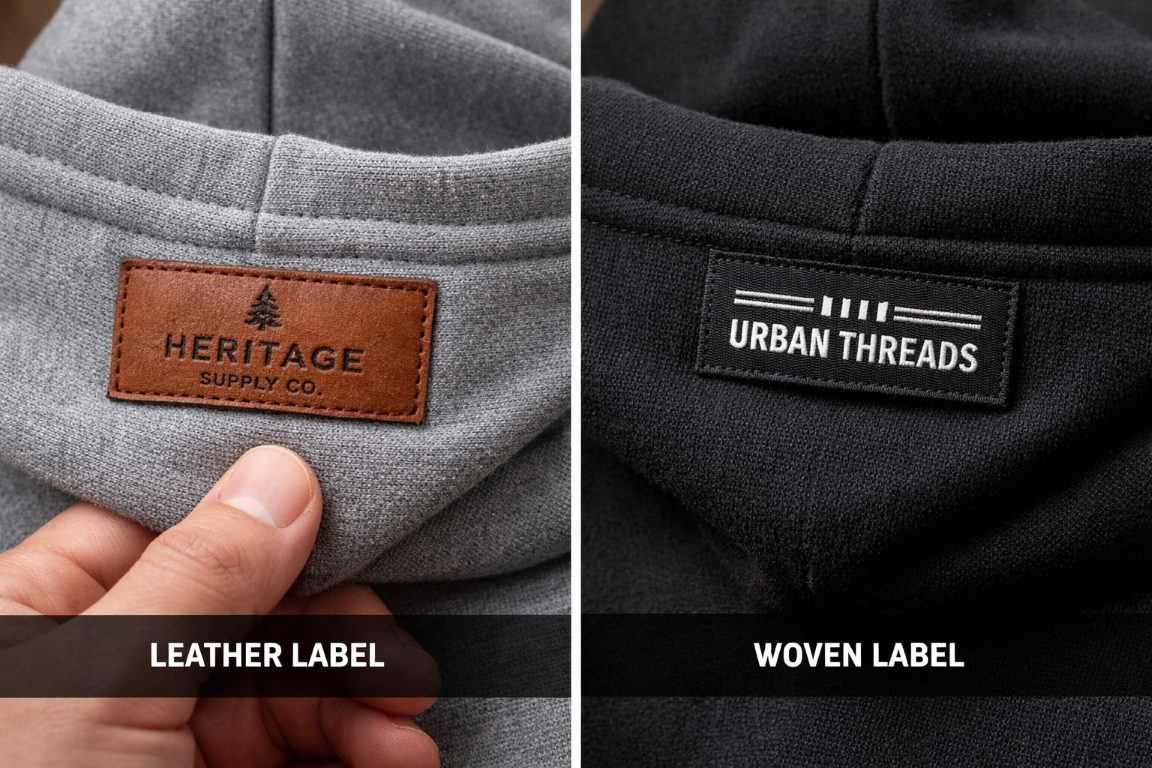
Woven labels are structured, precise, and detail-oriented. They’re commonly used for interior neck labels, size tags, and brand identification inside garments.
Leather labels introduce texture. They carry visual weight. They absorb light differently than thread. Even in small sizes, they create dimensional contrast.
In apparel, small material decisions quietly signal brand tier.
Woven often communicates:
- Clean professionalism
- Detail accuracy
- Classic construction
Leather often communicates:
- Intentional design
- Elevated collections
- Premium positioning
Neither is universally better. They simply send different signals.
When Woven Labels Make Strategic Sense
Woven labels are ideal when:
- You need sharp, fine logo detail
- Your garments are lightweight
- You want interior branding
- You’re producing higher-volume runs
- You need multiple colors reproduced precisely
For many apparel brands, woven labels form the foundation of their labeling system.
They’re versatile. Cost-efficient. Reliable.
If your brand leans toward minimalist tees, soft garments, or high-detail logos, woven labels are often the most practical and balanced choice.
When Leather Labels Elevate a Collection
Leather labels work best when they support structure and contrast.
They’re commonly used on:
- Hoodies
- Outerwear
- Denim
- Hats
- Structured garments
- Limited capsule collections
Leather doesn’t need to dominate a garment to make an impact. Even a small hem tab or back neck panel can shift perception significantly.
Because leather carries texture, it creates depth without adding color complexity.
For brands moving toward higher retail price points, leather often supports that transition visually.
The Role of Placement
Placement affects impact more than size.
Back neck leather labels feel refined and subtle.
Hem tabs create signature detailing without overwhelming the design.
Hat front leather patches become focal points.
On outerwear, sleeve or shoulder placements introduce dimensional contrast that thread alone can’t replicate.
If you’re not sure what size or placement makes sense for your garment type, reviewing a digital proof first prevents imbalance. Oversizing is one of the most common mistakes.
Finish Differences Matter Too
Material is only one part of the equation. Finish changes tone.
Debossed leather feels understated and minimalist.
Hot stamped leather creates bold contrast and sharper visibility.
Foil stamping adds metallic highlight.
Laser engraving delivers fine precision.
If your brand leans heritage or understated, debossing often aligns well.
If clarity and visibility are important, hot stamping provides stronger definition.
Choosing finish should match both garment weight and brand personality.
Real-World Scenario: Two Hoodie Brands
Imagine two hoodie brands priced similarly.
Brand A uses a woven neck label with detailed stitching.
Brand B uses a small debossed leather neck patch and a matching hem tab.
Both hoodies may be constructed from comparable fabric.
But customers often interpret Brand B as more elevated because texture influences perceived value.
This doesn’t mean leather is always required. It means material choice reinforces positioning.
For brands trying to move from “merch” to “designed product,” subtle texture shifts can make a measurable difference.
Cost Considerations
Leather labels typically cost more per unit than woven labels.
However, many apparel brands use leather strategically rather than universally.
Examples:
- Signature pieces within a collection
- Limited seasonal runs
- Higher-tier retail items
- Capsule releases
Even a single leather element can justify stronger perceived value when aligned with brand narrative.
The goal isn’t adding cost. It’s adding intention.
So Which Feels More Premium?
Woven labels feel polished.
Leather labels feel intentional.
Premium isn’t about material alone. It’s about alignment between fabric, finish, placement, and brand identity.
If you’re unsure which direction fits your apparel line, the smartest first step isn’t guessing.
It’s clarity.
Next Step: Get the Full Material Breakdown
We created a free Premium Branding Guide that walks through:
- Leather vs woven vs embroidered
- Placement strategy
- Finish comparisons
- Sizing rules
- Budget considerations
Download the Premium Branding Guide and explore your options with confidence.
Or request a free artwork review and we’ll recommend the best material direction for your garment type.
Small details shape perception.
Choose them intentionally.